

Inside the Barrel: A Deep Dive Into the Louisville Slugger Supra USSSA
Posted by The Experts at LongballBats.com on May 29th 2026
Travel ball parents and players have a lot of bat options thrown at them every season, and most of the marketing language sounds the same: "massive sweet spot," "explosive pop," "game-ready feel." It's noise. What actually separates a genuinely high-performing bat from a bat that's just packaged well?
Here, we cut through the marketing and get into what's actually happening inside the 2026 Louisville Slugger Supra USSSA, one of the more technically interesting bats Slugger has put out in recent years, and what the just-announced 2027 Supra tells us about where the line is heading.
Let's get into it.
What the Supra Is (and What It Replaced)
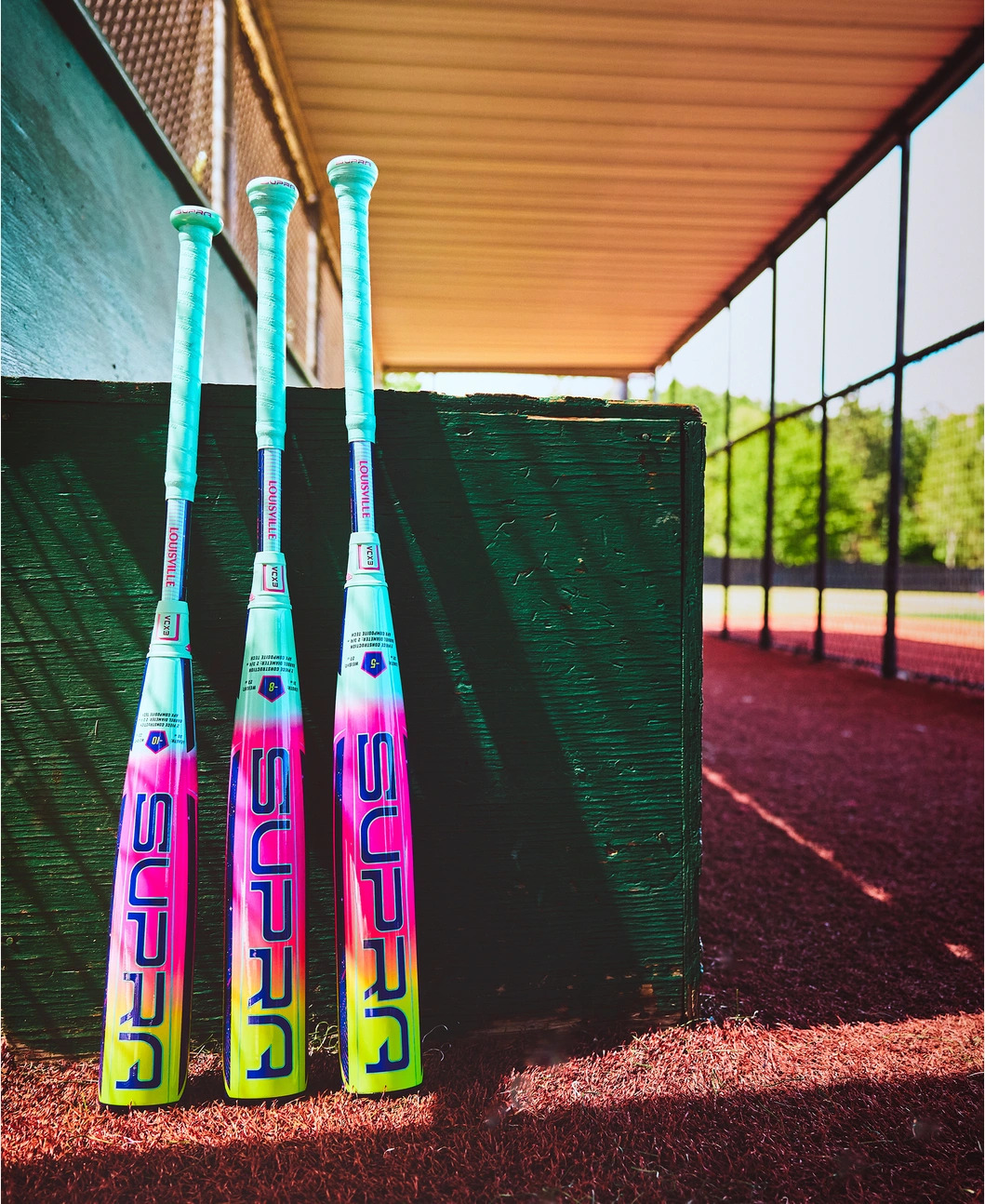
The Supra isn't a legacy line. Louisville Slugger introduced it to fill the performance and price-point space that the beloved Meta USSSA once occupied for younger travel ball players. Where the Meta was widely regarded as the performance ceiling of Slugger's USSSA lineup, the Supra was built to bring serious performance to a broader audience. It comes in -10, -8, and -5 drop weights, covering everyone from developing 8U and 10U hitters all the way to elite players transitioning toward BBCOR.
That's a wide net to cast, and Slugger pulled it off by building the Supra around a coherent, proven technology stack rather than a one-size-fits-all design. Each drop weight is a distinct instrument tuned for its player type while sharing the same core construction platform.
The Barrel: APX Composite Technology
The heart of the Supra is its APX Composite Technology Barrel, and this is where the real conversation starts.
==============================
Here at LongballBats, we're the bat performance experts and we LOVE performing our ProMAX Heat Roll/Break-In Process with Progressive Pressure on the Slugger Supra bats. We can't wait to get our hands on the USA and JBB versions when they're released, too!
We'll have them in stock the moment they drop. Contact us today to get on our launch list!
==============================
Composite barrels are made from layers of carbon fiber and resin. The performance characteristics of any composite bat are largely determined by how those layers are oriented, how tightly they're wound, and what the resin system's stiffness and flexibility profiles look like. Slugger doesn't publish their exact fiber layup specifications, and neither does any other manufacturer, because that's proprietary engineering. But what APX Composite Technology is designed to deliver is well-documented: a barrel that is soft and ready to perform, with a high-performance acoustic signature (that loud, crisp crack) on contact.
Here's why the "soft barrel" descriptor matters technically. Composite barrels work on what the industry calls a trampoline effect. When a ball makes contact, the barrel wall compresses inward, storing elastic energy, then rebounds, releasing that energy back into the ball and pushing exit velocity beyond what the batter's swing speed alone would produce. The USSSA standard (1.15 BPF, or Ball Performance Factor) regulates this trampoline effect, setting a ceiling on how much energy the barrel can return. Manufacturers engineer right up to that ceiling.
A softer composite barrel material means more compression on contact and, critically for younger players, more forgiveness on mishits across the barrel's face. When a ball doesn't hit the sweet spot perfectly, a softer barrel maintains more performance across a larger surface area. That's what produces a functionally larger sweet spot, not just barrel diameter, though that matters too.
The Supra's 2¾" barrel profile is the maximum allowable under USSSA rules, and Slugger exploits the full diameter to maximize that sweet-spot footprint. More barrel circumference means more surface area within the optimal deflection zone.
The XPND Performance End Cap
The end cap doesn't get nearly enough credit in most bat discussions, and it absolutely should.
The XPND Performance End Cap on the Supra is an engineered component, not just a plug to seal the barrel. Its job is to tune the barrel's performance profile at the extreme end, which is typically the weakest zone of any bat's sweet spot. As you move further toward the end of the barrel, the mass distribution thins out and the structural stiffness changes. Without intentional design, the end of the barrel becomes a dead zone where contact bleeds energy instead of returning it.
The XPND End Cap works by creating a controlled pivot point at the top of the barrel. By fine-tuning the stiffness characteristics at the cap interface, Slugger engineers effectively extend the functional sweet spot outward, reclaiming real estate that would otherwise be wasted performance. For a youth player whose barrel control is still developing, that extension of usable barrel isn't a minor detail. It translates directly to better at-bats.
There's a swing weight dimension here too. End caps made from composite materials are lighter than barrel walls, and reducing mass at the furthest point from the hands has a meaningful impact on the bat's moment of inertia, essentially how heavy it feels during the swing. A lighter end cap, all else equal, increases swing speed, which directly increases exit velocity.
Two-Piece Composite Construction
The Supra is built as a two-piece composite bat: a composite barrel joined to a composite handle through a connection system. The rationale for two-piece construction comes down to physics and feel.
In a one-piece bat, the barrel and handle are a single rigid structure. When the ball hits, vibration travels directly through the entire bat into the hands. That's feedback, but it's also sting, particularly on mishits where the ball contacts the bat outside the sweet spot.
In a two-piece construction, the junction between barrel and handle can be engineered to interrupt that vibration pathway. Slugger does this through the VCX3 Vibration Control Connection System.
The VCX3 is a patented elastomeric connection, a polymer-based interface between barrel and handle that allows a small degree of independent movement between the two sections. That independent movement means the barrel can flex and rebound relative to the handle rather than transmitting the full impulse force directly to the hands. The elastomeric material absorbs a portion of the vibration wave while still allowing structural energy transfer from swing to contact to occur efficiently.
The engineering balance here is delicate. Too much dampening and the bat feels dead. You lose feedback about where on the barrel you made contact, which is actually useful information for developing hitters. Too little dampening and mishits sting. The VCX3 represents the third generation of Slugger's VCX design philosophy, striking a balance that reduces sting without numbing the hitter's feel for the barrel.
Worth noting: the composite handle itself contributes to this feel profile. Composite handles are lighter and have different flex characteristics than alloy or wood handles, which contributes to the whip-like sensation at contact that players commonly describe with high-end two-piece composite bats.
The Feel Package: Grip and Knob
Performance doesn't stop at the barrel. The LS Pro Comfort Grip on the Supra features increased tack and cushioning, details that directly affect a hitter's ability to maintain a firm, consistent grip through the swing without fatiguing their hands during multi-game tournament weekends.
The Pro Design Knob Taper is similarly purposeful. Rather than an abrupt knob at the bottom of the handle, the Supra uses a softened taper that transitions gradually from handle to knob. This does two things: it allows the bottom hand to rest comfortably at the knob without pressure points, and it creates a subtle lever point that improves a hitter's ability to drive through the ball at contact. These aren't accidental aesthetics. They're ergonomic engineering.
What Changes in the 2027 Supra?
The 2027 Louisville Slugger Supra USSSA lineup has officially been announced, and we've been digging into the details carefully.
==============================
Here at LongballBats, we're the bat performance experts and we LOVE performing our ProMAX Heat Roll/Break-In Process with Progressive Pressure on the Slugger Supra bats. We can't wait to get our hands on the USA and JBB versions when they're released, too!
We'll have them in stock the moment they drop. Contact us today to get on our launch list!
==============================
The core technology platform, APX Composite barrel, two-piece composite construction, VCX3 Connection System, and XPND Performance End Cap, carries forward. That's not a knock on the 2027 bat. It means Slugger is confident in the platform and isn't changing things for the sake of change.
But there are meaningful differences worth understanding.
The barrel description language changes significantly. The 2026 Supra is described as featuring a barrel made with "updated composite material" that is soft and game-ready. The 2027 Supra language introduces a more specific mechanical description: the barrel "compresses on contact, then flexes, helping drive the ball all over the field." This isn't just copywriting. The compress-then-flex sequence describes a two-stage barrel response. Initial compression stores energy, and the subsequent flex and rebound phase amplifies energy return into the ball. This language suggests Slugger has refined the APX barrel's flex cycle, likely through adjustments to resin formulation, fiber layup angles, or barrel wall thickness profile. Those are the exact variables that govern how a composite barrel responds dynamically to impact.
The marketing positioning shifts from accessibility to aggression. The 2026 Supra was positioned as helping "travel ball's youngest players put their stamp on the game." The 2027 language leans into phrases like "offensive overdrive" and talks about hitters crushing extra base hits and driving the ball all over the field. This shift, applied across all three drop weights, suggests Slugger is pushing the 2027 Supra further up the performance spectrum. The target is players who want more from the barrel, not just players who want forgiveness.
The aesthetic is a complete overhaul. The 2026 Supra shipped in a Neon Mint and Pink colorway, bright and youth-market oriented. The 2027 Supra features a tricolor fade design that reads as more mature and premium. Color doesn't affect performance, but presentation communicates who the bat is for, and the 2027 is clearly speaking to a more serious travel ball player.
The -5 drop weight positioning evolves. The 2027 Supra -5 is explicitly described as a bat for "elite travel ball hitters preparing for the jump to BBCOR." That's deliberate. The -5 Supra is being framed as a bridge bat for high-level players approaching the BBCOR transition, with a balanced swing profile that begins preparing them for the heavier, stiffer demands of high school play.
Our Honest Assessment
The 2026 Supra USSSA is a legitimately strong performer. It's a well-engineered two-piece composite that plays above its price point, particularly for balanced hitters who make consistent contact. The APX barrel's break-in period is shorter than many competing composites, the VCX3 system handles vibration control well, and the XPND end cap delivers on its promise of extending the usable barrel.
The 2027 Supra, based on what Slugger has disclosed, looks like a refinement of an already solid platform with more aggressive barrel tuning. The compress-then-flex response cycle suggests a higher-performance composite layup aimed at pushing closer to the USSSA 1.15 BPF ceiling. The shift in marketing language mirrors what we'd expect to see confirmed in performance testing.
If you're shopping now, the 2026 Supra is an excellent bat at current pricing. If your player is heading into the 2027 season at a competitive travel ball level, the 2027 Supra warrants serious consideration, particularly the -5 if a BBCOR transition is on the horizon.
As always, we'll have hands-on testing data for the 2027 lineup as soon as bats are in hand. We never recommend what we haven't tested, and we never exaggerate what the data shows.
That's the standard. That's the job.
Questions about the Supra or any other bat? Reach out. This is what we do.